Using a freight forwarder for sea or air freight does not automatically mean they file the import customs declaration. In Korea, customs declaration is handled by a licensed customs broker. A forwarder's role is to coordinate the full logistics chain — from international shipping through customs liaison to cargo release and domestic delivery.
"If I'm using a freight forwarder for sea or air freight, will they also handle import customs clearance in Korea?"
This is one of the most common questions from import managers working with a freight forwarder for the first time.
Using a freight forwarder for sea or air freight does not automatically mean the forwarder files the import customs declaration on your behalf. In Korea, the import declaration is carried out by a licensed customs broker or an importer who meets specific qualifications. A freight forwarder's role is to manage the international transport schedule and cargo information — and where needed, to coordinate with a customs broker and oversee the flow from clearance through cargo release to domestic delivery.
When choosing a freight forwarder, rather than simply asking "can you handle customs?", the more useful question is whether the entire process — international shipping → customs coordination → cargo release → domestic delivery — is managed as a single connected workflow.
- How freight forwarders and customs brokers differ in role
- How international shipping connects to import customs clearance
- What gets checked in China–Incheon sea freight in practice
- What cargo information to prepare before customs clearance
- What unexpected variables arise during customs clearance
What Does a Freight Forwarder Actually Do?
When looking for a freight forwarder, most people start by comparing rates and transit times. But in practice, what happens after cargo arrives in Korea matters just as much.
Origin pickup, loading, sea or air freight, arrival at a Korean port, import customs clearance, cargo release, and final delivery look like entirely separate steps — but in reality, the information prepared at each stage directly affects the next. For example, if an Invoice or Packing List contains insufficient information, or if the declared contents do not match the actual cargo, additional checks will be required at the customs stage.
A forwarder that extends its service through to customs liaison does more than just complete the transport leg. It manages arrival schedules, passes documents to the customs broker, coordinates cargo release, and connects the chain through to domestic delivery.
| Area | Transport-Only Forwarder | Forwarder with Customs & Delivery Coordination |
|---|---|---|
| International freight | Yes | Yes |
| Arrival schedule management | Yes | Yes |
| Customs document handover | May require separate arrangement | Coordinated with customs broker |
| Import customs declaration | Customs broker or importer | Coordinated with customs broker |
| Post-clearance cargo release | Separate arrangement possible | Managed in line with transport schedule |
| Domestic final delivery | Separate request required | Available after confirming scope |
| Single point of contact | May vary by stage | Full progress coordinated with forwarder |
The key point is not that the forwarder replaces the customs broker. Each stage is handled by the right professional — but the forwarder coordinates the overall schedule so that international shipping, customs clearance, cargo release, and domestic delivery remain connected without gaps.
Freight Forwarders and Customs Brokers Have Different Roles
When discussing import customs clearance, it is important to distinguish between a freight forwarder and a customs broker.
A freight forwarder plans the transport from origin to destination and coordinates schedules with shipping lines, airlines, overseas agents, and domestic transport providers. Import declaration, HS code classification, and duty calculations are the domain of a licensed customs broker or equivalent specialist.
So when a forwarder says it can "support customs clearance," this typically means it coordinates with a customs broker, passes the necessary transport and cargo information, manages clearance status alongside the transport schedule, and connects through to cargo release and domestic delivery — not that the forwarder itself handles every customs formality.
| Party | Primary Role |
|---|---|
| Freight Forwarder | Origin pickup, loading, international transport, schedule management, document handover, customs liaison, release and delivery coordination |
| Customs Broker / Licensed Agent | HS classification review, import declaration, duty-related work, customs submission and clearance procedures |
| Importer | Providing accurate product information and trade documents, preparing required import permits, confirming duties and costs |
| Shipping Line / Airline | International transport and schedule operations |
| Domestic Carrier | Final delivery to destination after customs clearance |
What Happens When Import Cargo Arrives in Korea?
Customs preparation does not begin only after cargo arrives in Korea. Basic documents and cargo information can be reviewed in advance — during transit or even before loading.
1. Confirming Vessel and Arrival Schedule
The forwarder confirms the vessel or flight schedule and tracks when the cargo will arrive at a Korean port or airport.
2. Checking Customs Documents and Cargo Information
Along with the core shipping documents — Commercial Invoice, Packing List, and B/L — the forwarder confirms what additional information may be needed: product name, specification, quantity, value, origin, intended use. Depending on the product, a Certificate of Origin or additional permits, approvals, or inspection certificates may also be required.
3. Customs Declaration and Examination
Once documents are ready, a licensed customs broker or other qualified declarant files the import declaration. Not all cargo undergoes physical inspection — depending on the declaration and cargo type, either a document review or physical inspection may follow.
4. Duties, Taxes, and Required Procedures
The amount payable varies depending on HS classification, customs value, and applicable duty rates. Providing accurate product information from the enquiry stage onwards is important for reliable cost planning.
5. Customs Clearance and Cargo Release
Once all procedures are complete and the declaration is approved, the cargo can be released from the bonded zone or customs area.
6. Final Domestic Delivery
Depending on the importer's requirements, domestic transport to the final destination — factory, warehouse, or distribution centre — can be arranged as part of the same workflow.
The actual customs process varies by product, import requirements, declaration content, and whether a physical inspection is required.
Shanghai to Incheon — What Gets Checked in Practice?
Take sea freight from Shanghai, China to Incheon as an example. One of the first things a forwarder checks when arranging the shipment is the vessel and cut-off schedule.
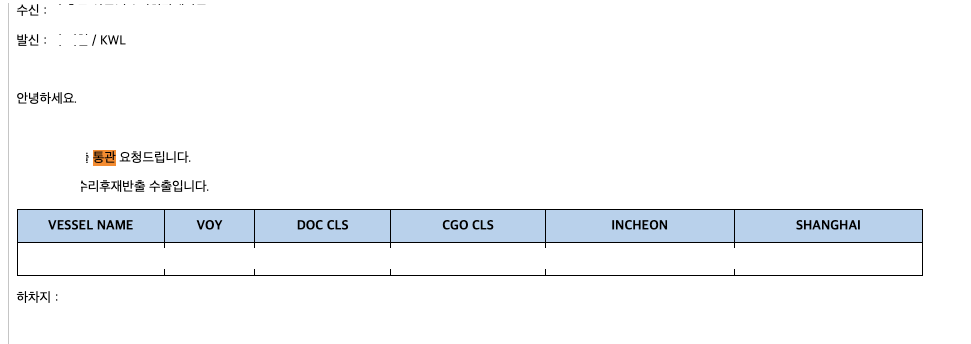
Sample vessel and cut-off schedule used when arranging China–Incheon sea freight
A schedule like this shows several key items, including VESSEL NAME, VOY, DOC CLS, and CGO CLS.
| Field | Meaning | Why It Matters in Practice |
|---|---|---|
| VESSEL NAME | Name of the vessel | Confirms which ship will carry the cargo |
| VOY | Voyage Number | Identifies the specific sailing of that vessel |
| DOC CLS | Document Closing | Deadline for submitting required shipping documents to the shipping line |
| CGO CLS | Cargo Closing | Deadline for cargo to be delivered to the port for loading |
| INCHEON | Incheon arrival schedule | Estimated time of arrival — basis for customs and delivery planning |
| SHANGHAI | Shanghai departure schedule | Estimated time of departure — confirms cargo readiness timeline |
DOC CLS and CGO CLS are not just reference times. If documents or cargo are not ready by the stated deadlines, the cargo may miss the planned vessel — requiring additional confirmation or schedule adjustment.
A forwarder does more than just make a booking. It confirms the vessel schedule, cargo readiness, and required documents together — coordinating the entire timeline.
Cargo Information Matters as Much as the Schedule
Even for the same China–Korea sea freight route, what you need to prepare depends on what you are importing. When contacting a forwarder, sharing the following information helps.
| Information | Example |
|---|---|
| Exact product name | Industrial machine parts |
| Intended use | Manufacturing process |
| Specification / Quantity / Weight / CBM | 10 CTNS / 850 kg / 3.2 CBM |
| Packaging type | Carton / Pallet / Wooden Case |
| Invoice value / Incoterms | USD ○○ / EXW, FOB, CIF, etc. |
| Country of origin | China |
| HS Code (if known) | For HS classification reference |
| Special conditions | Battery, liquid, powder, DG status |
| Cargo Ready Date | Target loading date |
| Final delivery location | Seoul / Gyeonggi / regional factory, etc. |
You do not need to know the HS Code to make an initial enquiry. However, for accurate HS classification, providing the product's material, function, intended use, and specifications — along with a catalogue or product photo if available — helps significantly. Where formal HS classification advice is required, consultation with a licensed customs broker is recommended.
Why Do Unexpected Variables Arise During Customs Clearance?
Import customs clearance does not follow the same process or timeline for every shipment. Depending on the cargo, additional checks may be required.
Discrepancies Between Declared and Actual Cargo
If the contents of the Invoice or Packing List differ from the actual quantity, specification, or product — additional confirmation or supplementary documents may be required.
HS Code Classification Review
The applicable tariff code can vary depending on the product's material, function, and intended use. Since the duty rate and import requirements can differ by classification, early preparation of detailed product information for borderline products is advisable.
Import Requirements
Certain products — such as food, chemicals, electrical and electronic equipment — may be subject to additional requirements under applicable regulations, including permits, approvals, inspections, or certifications. These requirements vary by specific product and applicable law, and must be confirmed on a case-by-case basis rather than assumed based on broad product categories.
Customs Inspection or Document Supplements
Not all import cargo is subject to physical inspection — but when cargo is selected for inspection or additional documentation is required, the timeline may extend beyond initial estimates. In these situations, what a forwarder needs is not a special relationship with customs — it is the ability to pass the right information quickly between the importer, customs broker, overseas agent, shipping line, warehouse, and domestic carrier, and to adjust the onward transport schedule accordingly.
What Information Should You Share When Contacting a Forwarder?
Sharing as much cargo information as possible from the start enables more accurate rate calculation and transport review.
| Information | Example | Why It's Needed |
|---|---|---|
| Origin | Shanghai, China | Confirms pickup and origin costs |
| Destination | Incheon, Korea | Determines route and destination costs |
| Product name | Industrial machine parts | Core information for transport and customs review |
| Qty / Weight / Volume | 10 CTNS / 850 kg / 3.2 CBM | Rate calculation and LCL/FCL assessment |
| Packaging | Carton / Pallet / Wooden Case | Handling and transport method |
| Invoice Value | USD ○○ | Customs reference information |
| Incoterms | EXW / FOB / CIF, etc. | Determines cost responsibility scope |
| Cargo Ready Date | Target date | Confirms realistic loading schedule |
| HS Code | If known | HS classification reference |
| Special conditions | Battery, liquid, powder, DG, etc. | Loading eligibility and additional requirements |
| Final delivery address | Seoul / Gyeonggi / regional factory | Post-clearance domestic transport planning |
You do not need to have complete information at the outset. The more cargo detail you can share, the more specifically the forwarder can assess transport options and what preparation is needed.
What Are the Benefits of Connecting Shipping, Customs, and Delivery?
It is possible to use separate providers for international shipping, import customs, cargo release, and domestic delivery. But when these stages are split across multiple parties, any change in schedule or documentation requires relaying the same update to each separately.
When shipping and customs are coordinated through a single forwarder, the forwarder has full visibility of the logistics timeline — making it easier to share arrival schedules, pass documents to the customs broker, connect back to the importer when supplements are needed, arrange vehicle dispatch at the point of clearance, and coordinate delivery after release.
At KWL, we handle not only sea and air freight but also review customs liaison and domestic transport coordination as part of the same process. If you are importing cargo from China, rather than checking the sea freight rate alone, confirming how the process connects through customs clearance and final delivery in Korea will serve you better in practice.
What to Check When Choosing a Forwarder for Shipping and Customs
When comparing forwarders, rather than accepting "yes, we handle customs" at face value, ask about how the process actually works.
- Can the forwarder handle origin pickup and loading in China?
- Do they provide vessel schedule and cut-off information in advance?
- Do they check the basic customs documents beforehand?
- Is coordination with a customs broker or licensed agent available?
- Is there a clear single point of contact if additional documents are needed during clearance?
- Can cargo release and domestic delivery be connected after clearance?
- Do they clearly explain which costs are included and which may arise separately?
Checking these points helps you assess not just whether the rate is low, but whether the forwarder can actually manage the full import process end to end.
Frequently Asked Questions
If you are importing cargo from overseas to Korea
Rather than sharing origin and destination alone, please also include the product name, packaging type, quantity, weight, volume, target date, Incoterms, DG status, and final delivery address.
KWL will review the cargo conditions and advise on the appropriate international transport mode, customs liaison options, and domestic delivery scope. → Get a freight quote
Related Services
Related Country
China Freight & Shipping →Related Case Studies
Related Articles
KWL Forwarding
Need a freight quote?
Talk to a sea freight, air freight, and project logistics specialist.
Get a fast and accurate quote — free of charge.